Skip to Content

Blog

The Sibelius Experiment

August 4, 2009 at 3:44 am UTC

Last year I wrote this post encouraging composers to work without computer notation software and write using only good old-fashioned pencil and paper. It was meant as a friendly bit of advice for emerging composers, but oh my god did it stir up some controversy. It seems that composers have very strong opinions about this, and the vast majority prefer the software. I got a lot of emails…

Daniel Spreadbury at Sibelius wrote this very thoughtful essay in response to my post, and I was very taken with his genuine desire to make his software better. As he said:

How do we, as makers of notation software, respond to the problems that Eric and other composers find?

Very, very cool that he was listening and responding, and I was tremendously honored by the gesture. So I wrote to Sibelius and told them that if they were willing to give me copy of Sibelius 6 (the latest version) that I would use it to write a piece and then blog about my experiences. And just like that, bam! Look what showed up on my doorstep:
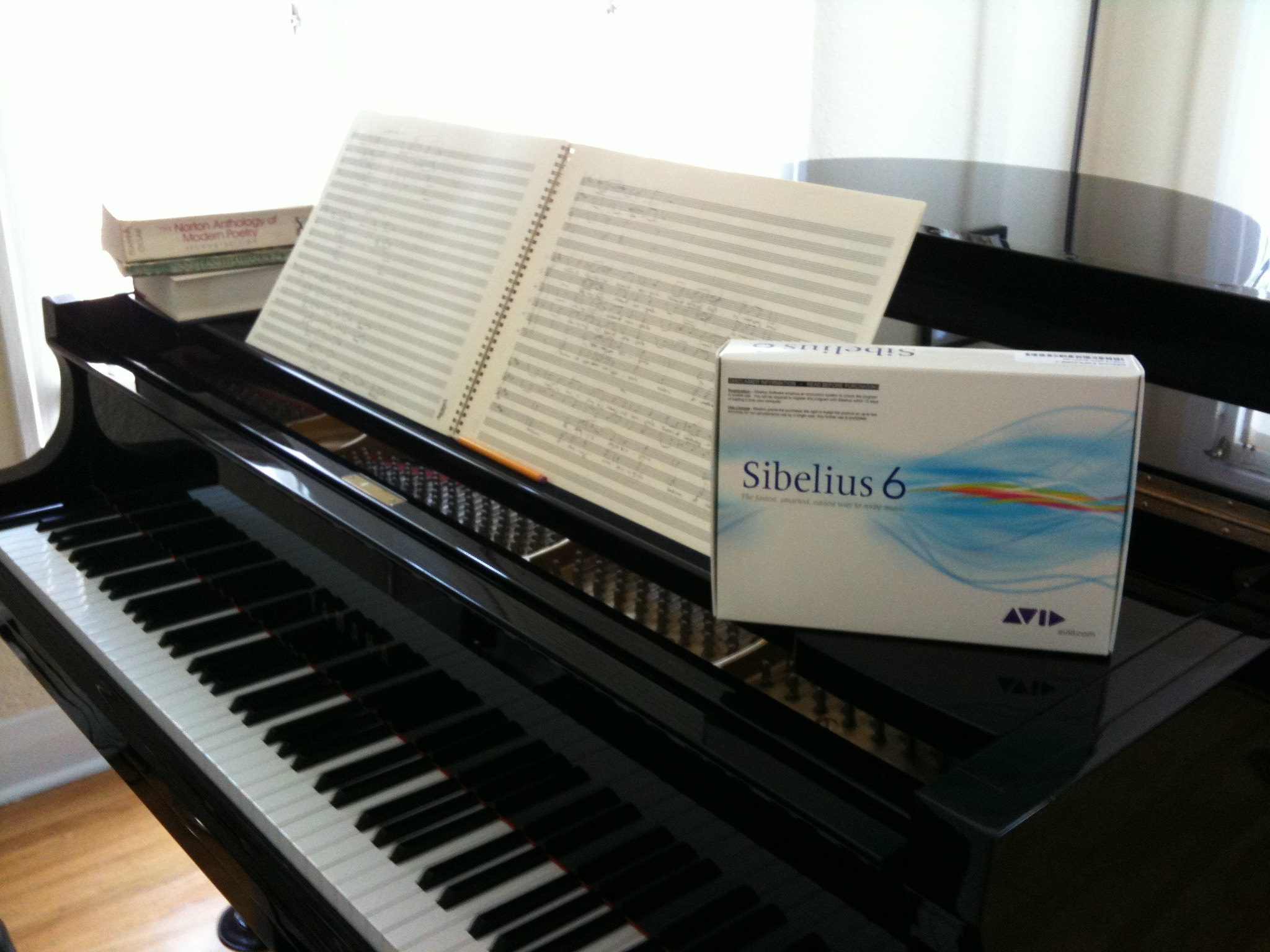
Sibelius on the piano

So I’m going to give it a whirl, and I will truly try to keep an open mind. I may be asking some of you for tech advice, but I’m hoping that it’s going to be as intuitive as everyone says it is. If you’re a Sibelius user, please write about your experiences in the comment section (good or bad).

Very excited to try something new.

  • http://glassmausoleum.blogspot.com/ Davis

    I'm a young composer, and I read your original post advising against notation software a few months back. At first I was slightly distressed, because I had invested in a copy Sibelius already and did not want that to be a mistake. I understood the points that you made, and so I backed off of the program, but I couldn't exactly throw it away.

    I continue to search for my writing niche, but I know that it will likely include notation software, because I can't deny that it has been very convenient. However, I still agree with you that convenience can be dangerous, so I try to check myself often to avoid getting off track. I also agree with Mr. Spreadbury's point that it is not the fault of the tool, but the user, if a composition goes awry.

    In short, I believe Sibelius is very useful, but the dangers you point out are valid and should be kept in mind by any composer that uses the software.

    P.S. I would like to thank you, because your advice did help me a great deal.

  • Mike Anderson

    I find notation software a bit cryptic, but I hope your experiences are positive.

    Where on EARTH do you get those giant binders of Blank sheet music? I would love to get my hands on one of those.

  • http://hotwaterishot.blogspot.com Matt

    Eric,

    As a Sibelius user for two years now, I can honestly say it was one of the best purchases I ever made. It's an amazing tool. Sometimes, I only use it to notate what I've already composed. But in that case, it's still worth every penny.

    I would highly recommend using the numeric keypad for notation entry. When I got my laptop, I went out and bought a supplementary USB numeric keypad for less than $20. It makes it faster, and in a strange way, almost makes the software feel like an instrument.

    By the way, what ever happened to the rest of that series for the emerging composer? I really enjoyed what I read and look forward to more blogs later on (you're busy, I understand).

    Anyway, have fun!

    Matt

  • Scott Haines

    I've been using it since original version came out, I think. I can't remember. I think it's a really simple program to use. There are a few annoying things when it comes to virtual instruments, but the program is worth it. I'm on Sibelius 5 still. If you need any advice, hit me up. You know how to get ahold of me. I hope you enjoy your free copy! I know I would. I'm curious to know what new features they have one it now. CHEERS! -Scott

  • http://blog.binary-snobbery.com/ greg

    It took a while, but Sibelius ended up being fairly natural and intuitive–giving me fairly granular control over everything on the page. I have been slowly forcing myself to go the pen-and-paper route, though… at least in the beginning.

  • Dan

    Eric Whitacre+Sibelius 6=Good combination!

    I too, am a young composer, who purchased Sibelius a few years ago. I find that paper/pencil+Sibelius makes a pretty killer combination. I usually write a good chunk of it just with the paper and pencil, and then I like to input it into Sibelius etc. Just my thoughts. :)

    Looking forward to what you think!

  • Celeste

    Good timing: my husband composes some and we've been trying to decide whether we should buy software or not. (Then there was the question whether to go Finale or Sibelius, but apparently that's answered.) I think you can hookup a synthesizer to the computer via USB and then play, right? Even if it's one part at a time that seems easier than a numeric pad, so I hope so. Then again, I'm not sure exactly what a numeric pad is…anyway, can't wait to hear how it goes. No pressure.

  • tessyeggerman

    I got Sibelius 4 a few years ago, and to be honest, I think it’s fairly easy to use and that the playback is pretty good. :)At times it does sound not-so-natural, BUT it’s not horrendous (perhaps it improved with the newer versions). :) For me, it’s great because I can hear the big picture of what my compositions sound like because I haven’t played piano since I was 10…so when I write things out on the piano I play very it slowly. lol

    But what I usually do is compose at the piano, and then input it into Sibelius. It’s a very handy tool. But I understand your points about using it too much and agree! Have fun with your new toy. I know I did. :D

  • tessyeggerman

    Ooops, I meant "play it very slowly". :)

  • ethan

    I usually start with pencil/paper, and use Sibelius just to finalize it, or take a look at the total structure of the thing.

    My pencil/paper process is messy–I compose chunks of a piece at a time, and these chunks (sometimes as short as a measure) are scattered randomly around the notebook, with a number by them for order. I do this so that I have room to add to the front or back of a chunk if I want to. Then when all my ideas are down, I copy them in order into Sibelius and look at the big picture for structural problems/flow, etc. Then the process starts over for orchestration.

    Overall I think Sibelius is a hugely useful tool for getting to look at your scores "pretty," that is, looking at or being able to hear, in a generalized way, a finished product. Sometimes when something never sounded quite right when composing on the piano, I fiddle around with it in Sibelius until it sounds the way I hear it… but it's always important to take it back to the piano to double-check.

  • Peter

    Eric,

    Your responsive, active, involved way of doing everything truly solidifies your position as THE modern composer. Every time I visit Soaring Leap I'm impressed by the active role you take in the music community, and the way you are active and responsive to your fans, admirers, colleagues etc.

    Needless to say, I'm nothing but supremely impressed with you.

  • rerodriguez

    As someone who owns Finale 09 and Sibelius 6, I must say, that I enjoy using Finale more than Sibelius. But it’s all about the user, not the software. The thing that always got me with Sibelius was that it was really easy to use, it was quick, and it was clean. But everything you need on Finale is looking right at your face, and allows for much more freedom

  • http://www.sibeliusblog.com Daniel Spreadbury

    Glad to hear you've got your hands on a copy of Sibelius, Eric. If you need any help at any point, feel free to drop me a line and I'd be delighted to offer you whatever assistance you might need. I'm looking forward to hearing what you think!

  • Peter Gates

    This is a conundrum for me too. I'm curious to see how this turns out.

    To any of you Photoshop wizards: would it be feasible to sharpen that photo and see what new piece that is on the piano? I'm rather curious. :D

  • Jeremiah W

    Eric,

    I began my composing career using Finale. I have only within recent years been able to write successfully without it, so it taught me a lot in the beginning. Albeit I’m still a young and learning composer, Finale has helped me tremendously music writing and analysis. Music software like Finale or Sibelius is excellent for early composers and musicians. I also know it’s great for producing and perfecting multi-voice music, especially for larger ensembles.

    I think you may find using Sibelius somewhat cumbersome at first. But, once you get used to the program, you’ll enjoy it more. You should be able to hook up a keyboard and enter notes that way. Not to mention the fact that it saves time from music creation to the final engraving process.

    I try to think of music notation software simply as a means to write music. It doesn’t replace natural creativity–it just makes writing it down much easier and more efficient.

    It’s tedious, but fun, and I hope you enjoy the experiment!

    JW

  • Scott

    OMG!!!! I'm soooo dying to get SIB 6!!! HAVE FUN!!!

  • Danny

    Eric, I used Sibelius in my high school music theory class last year to compose our senior project piece, and it's really easy to figure out. There are a few little quirks to get used to, but once you do, it really just flows. The only huge problem with it is if you try to use the live recording mode to just play a piano and have it notate what you're playing in time, you have to be 100% perfectly in time or it will make everything really screwy. Chords can get a little screwy too. But it's not that bad. Good luck with it, hope you have fun!

  • http://www.youtube.com/80FrontStreet Luke Ellard

    I have used Finale for a number of years and last year my music tech professor recommended for me to try Sibelius. I found that I like both, however, I mainly use Finale because Sibelius is quite a bit slower for me on my laptop without a numeric keypad. Though Sibelius did have a lot of things I liked so I would still use it despite my slow notation input.

    Your blog a long time ago really influenced me so much to try writing by hand. I've found that a lot of my more successful sketches of pieces come from just me, some 11×17 manuscript paper, and a piano. I'm unlucky enough to go to a school without any real help for students interested in composition, so your blogs have always helped me a lot. Thank you so much!

    Oh, and good luck with the experiment!

  • Jonathan D.

    Eric,

    As someone who has dabbled with both Finale and Sibelius, I find that both programs are rather complicated at first – for me, I was only able to learn by experimenting. With time, they both become relatively maneuverable.

    However, I find that I allow these programs to affect my compositional process very little. When I am composing, its just me, the piano, a paper and pencil. I tend to use shorthand forms of notation, sometimes sketching desired scale degrees or rhythmic figures as I go. The purpose of these programs, then, is simply to engrave and thus share my music. I tend to stay away from notation software until I have a sketch of a final product.

    The argument is often made that these programs are prized for their playback ability – again, this is something I try to stay away from until I have a final product. Yes, it is a useful crutch in a composer's early stage, but part of the challenge and beauty in what we do is translating the music which we can hear inside us into a form that others can appreciate and relate to. To me, this means learning to realize the music myself, whether by imagination, piano or a combination. I suppose its a bit old-fashioned, but I have always been wary of allowing these technologies to influence a composition before it is completed. As a writer of choral music, the text is always the source of my inspiration – not the influence of a machine.

  • Alice Night

    I also have been using Sibelius 4 for years and it has helped me tremendously one in learning, and two in writing a nice looking piece of music. As a professional composer you don't necessarily need those particular elements, but they are nice to have. Plus with the new edition sibelius 6 you can hook a keyboard up to your computer and play whatever you want into sib. and it will write it down. That just saves time in general, and is fun to do with sketches and such.

  • Ed

    Nice!!! Admittedly I never read your post on composing with/vs./without programs like Sibelius (I only started reading Soaring Leap about 3 months ago :)), but I remember you saying a great deal about this at your session in Kenosha.

    I hope it all goes well! I've composed 3 short-ish (about 3 minutes each) SATB a cappella songs myself using Finale, and although I definitely don't consider myself a "composer," I find the setup pretty useful. Never tried Sibelius, but if anyone can make beautiful music out of it I'm sure you're the prime candidate :D

  • Vaughan

    I feel your points are very legitimate. I do write music on the side for fun and am looking forward to your review. I personally like a mixture of technology, starting on the piano with a pencil and paper then transferring it into a program so it can actually be legible. I have been using Print Music 2007 by Finale but unfortunatly it is no longer adaquit. Your review along with me trying the trial version will hopefully help me deside how I should invest my money.

  • http://www.twitter.com/michaelnwmusic Michael

    I love Sibelius. I've used Finale before and I just find Sibelius to just be more user friendly and fluid. It's much quicker to input notation and create beautiful and clean sheet music. However, I have not tried composing/arranging using just pencil and paper. I don't think I would have the patience, but I think I would be willing to give it a try.

    I am really looking forward to your thoughts on the program though.

  • Alex Andrade

    Hi Eric.

    Like many others here, I too am a young composer experimenting with different ideas while still learning the best way to convey them. Having tried both Finale and Sibelius, I would say I prefer Sibelius. I currently use Sibelius 5. As a composer, I tend to have a hard time capturing ideas when I have them, as often I am nowhere near an instrument, manuscript paper, or a computer. When I do get ideas though, I often write them in manuscript if it is available; usually when I'm at the piano. Other times I'll just compose straight from Sibelius.

    Usually what happens is I'll hear an idea in my head and attempt to transcribe it in Sibelius. I've always used Sibelius for the final versions of my scores, as it allows me to hear the whole thing as well as have it neatly organized and written out.

    Of course, I think that there are definitely advantages to using simply pen and paper. Mainly that it's completely organic and allows you to write things that Sibelius often can not play back and is difficult to figure out how to notate in Sibelius. One thing I've noticed is that Sibelius does not allow you to write in a time signature ending in the middle of a tuplet. Granted I'm not sure how you would notate such a thing anyway…

    In general, my only gripes with Sibelius are the generally awful MIDI sounds, but there's not much to be done about that other than buying sound sets. Even them some of the sound sets are pretty bad. Also notable is that in larger scores with many different instrument patches some of the voices will cut out every now and then because there are simply too many voices being played for the MIDI to process. So really, it's not a problem with Sibelius as much as just general MIDI.

    Regardless of whether or not you find use for Sibelius, I certainly look forward to your future pieces and wish you luck.

  • http://[email protected] Michael Wallace

    I have been a notation software user for over 20 yrs now. The real ace in the hole that notation software brings to the composer is copying parts, editing parts and scores, and duplication of parts after the composition process is finished. The iceing is playback. (i.e. you can now hear bad voicing etc. before you take your chart to the rehearsal). I have always looked at notation software from that perspective and not as a replacement for pen and pencil. I have used Finale for a long time and have tried Sibelius. Both are amazing composition tools I believe that Sibelius has made incredible strides but it still does not have the depth (although you may never have to use the depth) of Finale.
    Mike Wallace

  • http://www.facebook.com/people/Will-Valenti/5505168 Will Valenti

    I started using Sibelius in high school, about six or seven years ago. At that point, I'd only been writing by hand for about three years. Most of the actual work I was getting at the time was arranging and copying, and the software made both of those tasks infinitely easier. Now that I've had some more experience with writing my own works and having them performed by humans, I have to say that I mostly use the software just before the orchestration phase of my process. I still sketch out melodies and fragments by hand and still sit at a piano when that's necessary. I still sketch out forms by hand, but filling them in on a score is something I barely touch a pencil to at all. Most of that work is just more convenient in Sibelius. I also do some "free writing" in Sibelius, since, when hooked up to a MIDI controller input, I can input as fast as I can think. However, I generally do this with my computer's sound turned all the way off. I have a set-up where my controller keyboard can stay on a piano-like sound while my computer is not making a sound, and I find this works out to be very similar to writing something by hand at the piano, except it's faster and results in fewer hand cramps. I also like being able to add systems and staves, and take them away at a moment's notice (in order to sketch things and look at them next to what I have already written). This is something that could become quite cumbersome on paper, at least as elaborately as I do it. The last thing that I want to mention is, spending a lot of time in public school classrooms with school-age ensembles, having access to something that I c

  • http://www.facebook.com/people/Will-Valenti/5505168 Will Valenti

    I started using Sibelius in high school, about six or seven years ago. At that point, I'd only been writing by hand for about three years. Most of the actual work I was getting at the time was arranging and copying, and the software made both of those tasks infinitely easier. Now that I've had some more experience with writing my own works and having them performed by humans, I have to say that I mostly use the software just before the orchestration phase of my process. I still sketch out melodies and fragments by hand and still sit at a piano when that's necessary. I still sketch out forms by hand, but filling them in on a score is something I barely touch a pencil to at all. Most of that work is just more convenient in Sibelius. I also do some "free writing" in Sibelius, since, when hooked up to a MIDI controller input, I can input as fast as I can think. However, I generally do this with my computer's sound turned all the way off. I have a set-up where my controller keyboard can stay on a piano-like sound while my computer is not making a sound, and I find this works out to be very similar to writing something by hand at the piano, except it's faster and results in fewer hand cramps. I also like being able to add systems and staves, and take them away at a moment's notice (in order to sketch things and look at them next to what I have already written). This is something that could become quite cumbersome on paper, at least as elaborately as I do it. The last thing that I want to mention is, spending a lot of time in public school classrooms with school-age ensembles, having access to something that I can work in, and almost instantly have parts and a score printed out, has proved helpful in hundreds of circumstances over the last few years.

  • Dinah

    I've done a little bit of writing with Sibelius, and some with Finale. Comparing them, I definitely like Sibelius better, I found it much easier to use. It did take me a while to figure it out though, I fought with it for a bit because I didn't want to read the manual. I still sometimes have trouble finding features I want.

    Usually I will write with pencil and paper first, (it's much easier to write piano music at the piano, and my computer is in a different room!) and then I'll transfer it to Sibelius and make the final changes and polishes there. All in all I find it to be a great, useful program. I hope you have a good time using it, I'd love to hear your thoughts on the subject.

  • http://members.sibeliusmusic.com/joshuajacobtaylor Joshua

    I started working with Sibelius when I was a freshman composer in college. I did not have the technical know how (theory etc.) to write pen to paper and it be at least some what legible. So, I found myself requesting to work in the music lab just so that I can write everything that was in my head with Sibelius. But more to the point – I write my music intuitively and so, Sibelius helps me a tremendous much by allowing me to actively see and experiment with what I'm doing on a staff. Besides all this, I'm a terrible piano player and now I don't have to mess with a keyboard anymore.

  • Jenny Minniecon

    Hi, I am looking at Sibelius because it was recommended to me, but looking at all the comments I am a little confused as if this will help me? First of all I do not read (or write) music, I am 48yrs old and do not intend on learning to…lol. BUT I DO "write" songs and play by ear and this causes frustration when the only way I can teach anyone else my songs is to play it and they have to also pick it up by ear. I was told with this program, I could sing and play my songs (on keyboard) and this program would put it all on paper for me, is this true??? I dont play professionally, but in christian ministry, although I believe the songs I write are a gift and could go further if I knew which direction to take. My dream is to hear other artist sing the song I write…. any helpful comments appreciated… Thankyou:)

  • Cam Millar

    Sorry Jenny…. but playing or singing 'freely' into Sibelius (or any other notation program capable of "transcribing" your music) will just leave you with a big musical mess. (it's getting better, though). You won't be creating anything that is easily readable by any musician…. what you create will need a lot of editing in order to get it into any kind of acceptable notation. You'll still need a good, 'traditional', musical background to make sense of it, or hire someone with knowledge of arranging and composing to figure it out for you.

    In order to have 'ready-made' music transcription, you'd have to play in your music at a tempo that might not feel very comfortable to you….. you'd probably lose the 'spirit' of your music…. but the automatic transcription would do a pretty good job at figuring out your notation…… it means you'd have to play things at a slower tempo than you'd most likely be comfortable with when performing. Try it and see how it feels. Read all the Sibelius Help and look at the tutorials.

    But… hey!….. you're never too old to learn anything!…… don't take this wrong (because of the title!)….. but one of the best books on learning music is the book in the "… for Dummies" series….. I think it's called "Music Theory for Dummies" (I have it in a box somewhere)……. it's a great book!…… has "all you need to know" information, and can really get you on the right track. Check it out! Good luck!

  • Cam Millar

    Jenny… here's the proper title of the Music Theory book I mentioned:

    "The Complete Idiot's Guide to Music Theory" …. by Michael Miller

    ……(it's in the "Idiot's" series, not the "Dummies" series)

    It's useful for all of us!…. beginners and experienced!

  • Keith Moss

    Sibelius is the most essential tool I can suggest for any composer.

    In some parts of the world there are no such things as publishers and score producers, it has to all be done by the composer.

    Sibelius is really the fastest way to produce scores and arrangements, as well realize your own creativity in original compositions.

    Your only limit is yourself. Not technology.

  • Christian

    Monsieur Whitacre, in light of this video (Barbershop/Star Trek), I seriously recommend a barbershop piece.
    http://www.youtube.com/watch?v=tV7GfydJ9A4

  • Nick

    I wish that I could offer that challenge to Sibelius so I could get the software!

    In all seriousness though, I've noticed with my own compositions, when I write the framework (chord sequence, melodies, etc) on piano, then really work it out on Sibelius, I get the 'best' effect.

    My own thoughts though.

    –Nick

  • Karen Taylor

    Can you tell me what software you used for your video choir? I am a teacher for gifted students and would like to create something like this when we study sound and pitch.

    Thanks so much,

    Karen

  • Jamie Diamond

    Any updates on this one?

  • http://www.spotlightmusic.org John Wales (jomusich

    I have used Sibelius since 2001 (and Daniel has helped me with several ID10T moments) and I have found the software to be very useful AFTER I have completed my drafts. It has made my scoring more efficient and brought to light several instances of incorrect transcription. I just found your music, and would love to arrange one of them someday.

    The software should be a tool, like a pencil. Not a crutch.

  • Kyle Watson

    I really do love using Sibelius, it is an excellent program. I was curious as to where you got that manuscript paper, I can’t seem to find it anywhere.

About Eric

Eric Whitacre is one of the most popular and performed composers of our time, a distinguished conductor, broadcaster and public speaker. His first album as both composer and conductor on Decca/Universal, Light & Gold, won a Grammy® in 2012, reaped unanimous five star reviews and became the no. 1 classical album in the US and UK charts within a week of release... full bio